By card, through Stripe, either from their own portal or from a payment link you send them. The link opens the invoice directly — they do not need to log in or remember a password to pay you.
Before they turn up
They've already paid before they open the door.
Asking a 17-year-old for £35 at the kerb, in the rain, is nobody's favourite part of this job. Neither is the message on Sunday evening saying they will settle up next week, or the running total in the back of your head of who owes you what. Chasing money is the least skilled thing an ADI does and it eats the most goodwill.
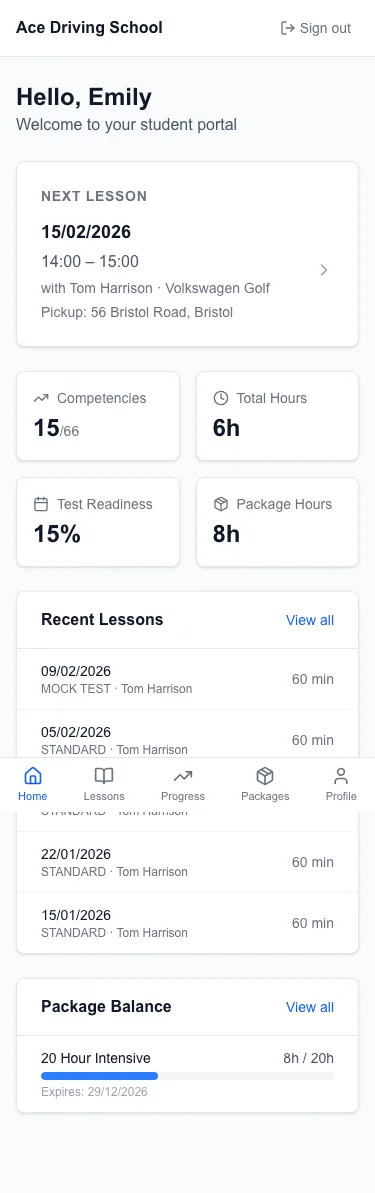
Pupils buy blocks themselves, on their phones
You set up the packages you sell — ten lessons, twenty, an intensive — and they appear in your pupils' portal. A learner buys one on their phone, pays by card through Stripe, and the lessons land on their balance. You were not involved. You did not have to ask.
For a lot of instructors this is the single biggest change, and not for the reason they expect. The money arriving earlier is useful. Never having to raise the subject is what they actually notice.
The pupil who has paid turns up
Pre-payment is usually sold as a cash-flow feature. Its more valuable effect is on cancellations. Someone paying per lesson loses nothing by pulling out on a Sunday night — someone who bought ten hours in advance is spending their own money by not being there. A block booking quietly does the job that reminder texts are trying and mostly failing to do.
For everything else, a link they can tap
Not everyone will pre-pay, and some pupils will always pay in cash. Outstanding invoices get a payment link that opens the invoice directly — no login, no password reset at 9pm, no reason to put it off. Cash, bank transfer and cheque can be recorded against the balance too, so the ledger reflects reality however the money turned up. Invoices, payments, package balances and outstanding requests all sit in one view, which means 'who owes me what' stops being a thing you carry around in your head.
How it works
- 1
Connect Stripe
From settings, once. The money goes to your account. Card details never touch you or us.
- 2
Set up the blocks you sell
Name them, price them, and they appear in every pupil's portal.
- 3
Stop thinking about it
Pupils buy, balances draw down as lessons are taken, and anything outstanding gets a link to tap.
Questions about payments
Yes, and you connect it from your settings. The money goes to your account, not ours. Stripe handles the card details, so they never touch DriveSchoolPro or you.
Yes. Plenty of pupils still hand over cash, and you can record cash, bank transfer or cheque against a pupil's balance so the ledger stays right regardless of how the money arrived.
A package of lessons bought up front — five, ten, twenty, whatever you sell. You set them up once and pupils can buy them from their portal. Each lesson counts one off the balance, and both of you can see how many are left.
Related: How lesson packages work
It changes the incentive. A pupil paying per lesson loses nothing by cancelling on a Sunday night; a pupil who has already bought ten hours is spending their own money by not turning up. It is not a guarantee, but it is a different conversation.
Related: More on reducing no-shows
Not currently. Pupils pay per invoice or buy lesson blocks up front. Recurring lesson series is coming soon, which is the related piece most instructors ask about.
Never ask for money at the kerb again
Free until 31 March 2027. No card, no contract, cancel any time.
Get started free →Related
- Scheduling → — the lessons those hours get spent on
- Reviews → — turning finished pupils into the next ones
- Accounting and invoicing → — the longer guide