How to Start a Driving School in the UK: Costs and Steps

Built and sold RevelationPets.com. First Class Honours in Software Engineering. 20+ years in SaaS.
Starting a driving school means two things at once: qualifying as an approved driving instructor (ADI) with the DVSA, and setting up a small business that can find pupils, take payments and keep you legal. This guide covers both, in the order you will do them: the 8 DVSA steps and their fees, what else to budget for, business setup, insurance, the car, pricing, finding your first pupils and running the diary with driving school software.
Everything below applies to car instructors in England, Scotland and Wales. Northern Ireland has a separate process.
How much does it cost to start a driving school?
The only fixed costs are the DVSA’s. Everything else depends on where you live, the car you choose and how much training you need.
| Cost | Amount | Notes |
|---|---|---|
| ADI part 1 theory test | £81 | Multiple choice plus hazard perception |
| ADI part 2 driving ability test | £111 | You get 3 attempts |
| Trainee driving instructor licence (optional) | £140 | Lasts 6 months, after passing part 2 |
| ADI part 3 instructional ability test | £111 | A real lesson with one of your pupils |
| First ADI registration | £300 | Lasts 4 years, then renew for £300 |
| Official DVSA fees | £603 | £743 with a trainee licence |
Fees from GOV.UK’s Become a car driving instructor step-by-step guide, checked November 2026.
On top of the DVSA fees, budget for:
- A DBS check. You need a new one to start your application, even if you already have one.
- ADI training. The DVSA tells you to get a registered trainer to prepare you for the three tests. Course prices vary a lot, so compare what is included (hours in the car, part 3 coaching, resits).
- A car. Bought, financed or leased, plus dual controls fitted by a professional.
- Driving instructor insurance. Ordinary car insurance does not cover paid tuition. Get quotes early because the premium is one of your biggest running costs (see our driving school insurance guide).
- Roof sign, livery and a simple website or Google Business Profile.
- Working capital to cover fuel, finance and insurance for the first few months while your diary fills.
- A franchise fee, if you join a franchise instead of going independent (see the driving school franchise guide).
To see whether the numbers work for you, put your local lesson price, hours and costs into the free driving school earnings calculator. It shows your effective hourly rate after cancellations and expenses, and your break-even point.
The 8 steps to becoming an ADI
The DVSA’s own step-by-step guide has 8 steps. Here they are with what each one means in practice.
1. Check you are eligible
You need a full driving licence, and the DVSA checks whether you are a “fit and proper” person to be an instructor. The rules differ slightly depending on whether your licence is manual or automatic, so use the DVSA’s online eligibility checker before you spend money, and read its guidance on the skills and knowledge an instructor needs.
2. Apply and get a DBS check
You apply to become an ADI online. You must get a new Disclosure and Barring Service (DBS) check to start the application, and agree to the responsibilities in the ADI register guide.
3. Get a trainer
The DVSA tells you to get a registered trainer to prepare you for the 3 qualifying tests. Trainers are on its official register of driving instructor training, often called ORDIT. A good trainer prepares you for all three tests, especially part 3, which is about teaching, not driving.
4. Pass ADI part 1: theory and hazard perception
Part 1 costs £81. To pass the multiple-choice section you need at least 85 out of 100 overall and at least 20 out of 25 in each of the 4 categories. For hazard perception you need at least 57 out of 75. Once you pass part 1, the clock starts: you must pass parts 2 and 3 within 2 years or start again.
5. Pass ADI part 2: driving ability
Part 2 costs £111 and takes around an hour. It includes an eyesight check, “show me, tell me” questions, general driving, manoeuvres and independent driving. You pass with 6 driving faults or fewer and no serious or dangerous faults. You have 3 attempts.
6. Get practice teaching (optional trainee licence)
After part 2 you can apply for a 6-month trainee licence (the “pink badge”) for £140, once you have done at least 40 hours of training with a qualified ADI. It lets you give paid lessons while you prepare for part 3. Some trainees find it invaluable; others find that a full diary of real pupils leaves too little time to prepare.
7. Pass ADI part 3: instructional ability
Part 3 costs £111. An examiner watches you give a client-centred lesson to one of your own pupils for about 45 minutes, with the pupil driving for about 40 of them. It assesses lesson planning, risk management and your teaching and learning strategies.
8. Register as an ADI
You must register within 12 months of passing part 3. Your first ADI certificate (the green badge) costs £300 and lasts 4 years. Only then can you charge for lessons as a qualified instructor. From then on you have at least one standards check every 4 years, and you renew your registration and DBS check every 4 years.
Setting up the business
Sole trader or limited company?
Most new instructors start as sole traders:
- Sole trader: register for Self Assessment with HMRC, keep records of income and expenses, and file a tax return by 31 January after each tax year. Simple, but you are personally liable for business debts.
- Limited company: register with Companies House, file annual accounts and a corporation tax return, and pay yourself through the company. More admin, but limited liability.
If you plan to build a multi-instructor school, talk to an accountant about the structure before you take on other instructors.
Making Tax Digital
Making Tax Digital for Income Tax applies to sole traders by income before expenses: over £50,000 from 6 April 2026, over £30,000 from 6 April 2027 and over £20,000 from 6 April 2028. A busy full-time instructor can pass £30,000 in lesson fees even if their profit is much lower, so set up digital records from the start. Our Making Tax Digital guide for driving instructors explains the thresholds and quarterly deadlines, and the MTD record keeping guide lists the records to keep.
Independent or franchise?
A franchise gives you a brand, a car and often a flow of pupils in exchange for a weekly fee. Going independent means finding your own pupils but keeping all your lesson income. The right answer depends on how quickly you need a full diary and how comfortable you are with marketing. The franchise guide compares the two.
Insurance
You need specialist driving instructor insurance. Check that the policy covers:
- tuition by learner drivers, with and without dual controls in use
- public liability
- your business use of the car
- what happens if the car is off the road (a courtesy car you can teach in)
Our driving school insurance guide explains each type of cover and what to ask insurers.
Choosing your car
Dual controls
Dual controls are not a legal requirement, but almost every instructor fits them and insurers usually expect them. Have them fitted and checked by a professional, and remember to budget for removal when you sell the car.
Which car?
Instructors tend to choose small, reliable, economical hatchbacks with good visibility, because learners find them easy to drive and parts are cheap. Before you buy, check what insurers charge to cover the model for tuition; it can differ a lot between similar cars.
Manual or automatic?
Look at your local market before you decide. If learners near you struggle to find an automatic instructor, an automatic car can fill your diary faster. Remember that a pupil who passes in an automatic can only drive automatics, so some pupils will always want manual lessons.
Buy, finance or lease?
- Buying outright keeps monthly costs low but ties up cash and leaves you paying for repairs.
- Finance (such as PCP) spreads the cost of a newer car with a warranty.
- A business lease gives a fixed monthly cost. Ask your accountant how each option is treated for tax.
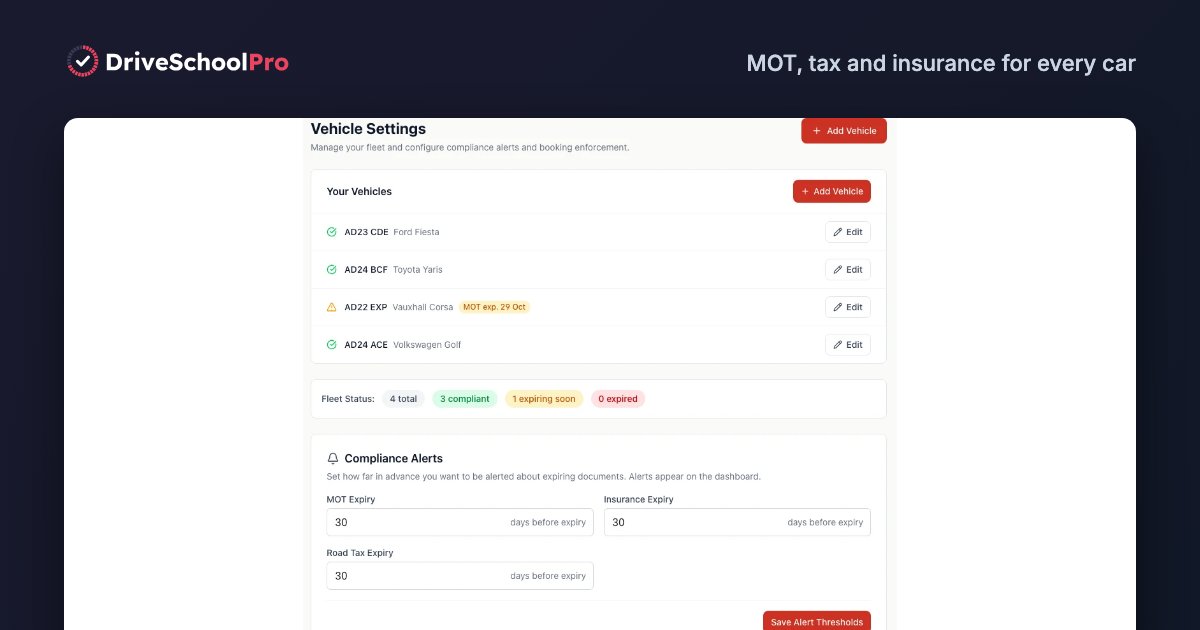
Whatever you choose, track your MOT, insurance, road tax and service dates. Teaching in a car without valid insurance or MOT is a serious risk. DriveSchoolPro records these dates for each car, alerts you before they expire and can stop lessons being booked in a car whose insurance or MOT has run out (see vehicle tracking).
Setting your lesson prices
Research local rates
Search for instructors in the postcodes you plan to cover and note what they charge for manual and automatic lessons, block bookings and first lessons. Our learner cost calculator shows typical lesson prices by city.
Block bookings and packages
Selling lessons in blocks gives you committed pupils, fewer cancellations and money up front. Decide your block sizes and discount before you launch, and keep it simple. DriveSchoolPro tracks lesson packages and pupil balances so you always know how many prepaid lessons a pupil has left.
Introductory offers
A discounted first lesson helps a new instructor fill a diary, but limit it to one per pupil and do not price so low that it attracts people who never book a second lesson.
Review prices regularly
If you are booked up weeks ahead, your prices are probably below the local market. Review them at least once a year.
Finding your first pupils
Google Business Profile
Set up a free Google Business Profile before your first lesson. It is what appears when someone searches “driving lessons near me”. Choose “Driving school” as the category, set your service area, add photos of your car and start asking every pupil who passes for a review. Our SEO guide for driving schools covers the rest of local search.
Local Facebook groups
Learners and their parents ask for instructor recommendations in local community Facebook groups. Join the groups for the areas you cover and be useful: answer questions about tests, prices and waiting times, rather than only posting adverts.
Your car
A clear roof sign and livery with your phone number and website turns every lesson into an advert.
Schools, colleges and directories
Ask local sixth forms and colleges whether they have a noticeboard or careers event you can use, and list yourself in instructor directories. Most basic listings are free.
Referrals
Your passed pupils’ friends and siblings are your best source of new pupils. Ask for referrals and make it easy for people to book.
Running the diary and admin
The teaching is the part most new instructors look forward to. The admin is the part they underestimate: booking enquiries, rescheduling, chasing payments, tracking which skills each pupil has covered, and keeping the car legal.
Paper diary or software?
A paper diary and WhatsApp work for a handful of pupils. They get harder when you have many pupils at different stages, payments to reconcile and a cancellation to fill at short notice. Our guide to switching from a paper diary covers the move in detail.
DriveSchoolPro is built for UK ADIs and driving schools. It gives you:
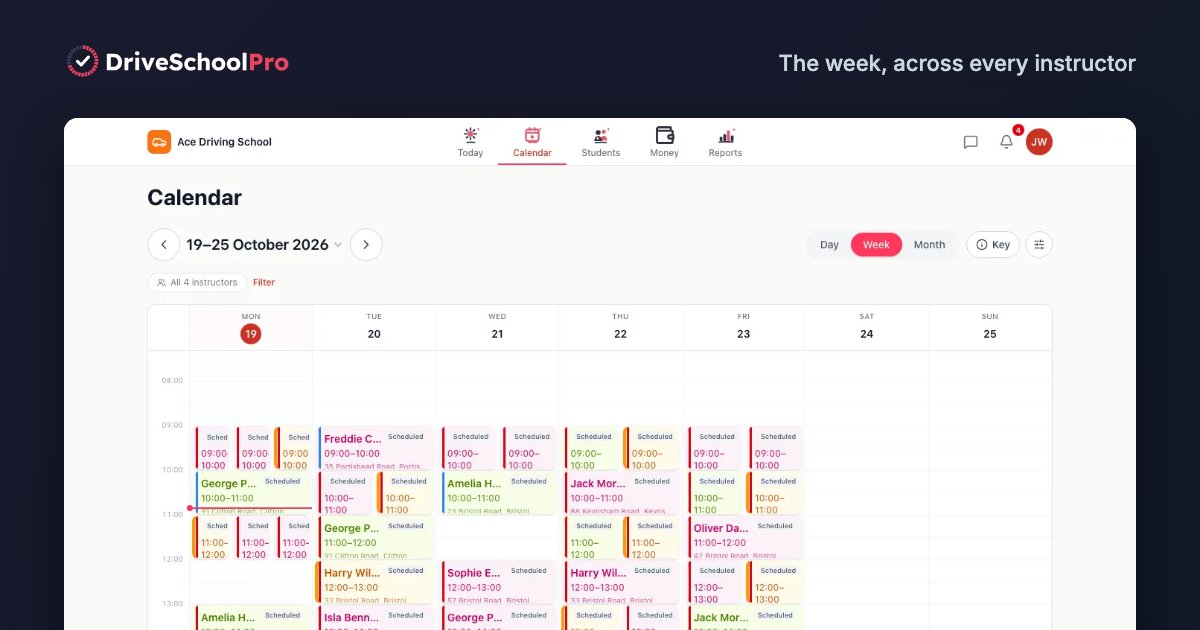
- a diary with day, week and month views, drag-and-drop rescheduling and clash checks
- an online booking widget so pupils can book within the rules you set, with a buffer between bookings
- progress tracking against all 27 skills in the DVSA framework, recorded lesson by lesson
- automatic email reminders before every lesson
- card payments and invoices through Stripe, plus cash and bank transfer recording
- MOT, insurance and service tracking for each car
It is free until 31 March 2027 during early access, with no card required. To compare it with other options, read our best driving school software guide.
Set a cancellation policy before you start
Decide how much notice a pupil must give to cancel without paying, put it in writing when they book, and apply it consistently. Our guide to reducing driving lesson no-shows has practical ways to cut missed lessons.
Growing into a multi-instructor school
Once your own diary is full, you can grow by:
- Taking on associate instructors who teach under your brand and pay you a fee.
- Employing instructors, which gives you more control but brings employment obligations.
- Franchising your brand to other ADIs, which needs a proven model and legal advice.
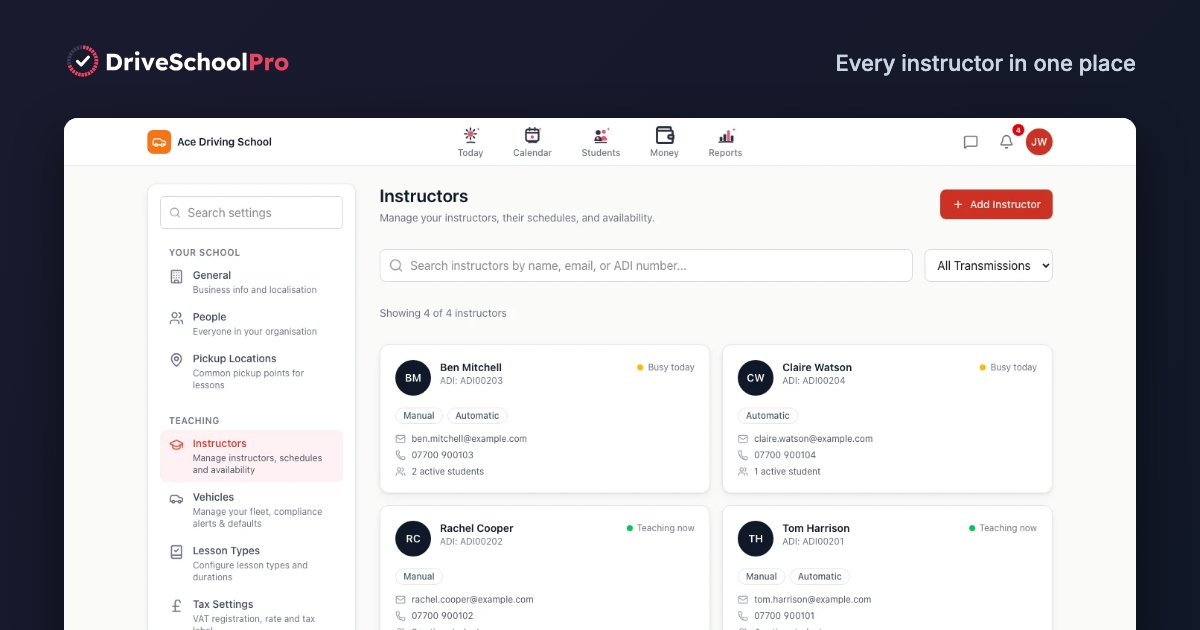
Each instructor adds pupils, cars and payments to keep track of. DriveSchoolPro works for a single instructor or a multi-instructor school, with one shared diary, a login for each instructor and office staff, role-based access and clash checks across pupils, instructors and cars. See the driving school management software page for how it works for schools.
Common mistakes to avoid
- Underpricing to fill the diary. Once you are known as the cheap option, it is hard to raise prices.
- Not tracking pupil progress. Without a record of skills covered, test-readiness decisions become guesswork.
- No cancellation policy. Every missed lesson is income you do not get back.
- Letting car paperwork slip. An expired MOT or insurance policy can stop you working.
- Underestimating part 3. It tests teaching, not driving. Budget for proper training.
Ready to set up your driving school?
When you are ready to take your first bookings, get started free with DriveSchoolPro. It is free until 31 March 2027, with no card required.
Related articles
DriveSchoolPro is free while we're in early access — until 31 March 2027.
Get started freeNo credit card required.