Making Tax Digital for Driving Instructors: Do You Need It in 2027?

Built and sold RevelationPets.com. First Class Honours in Software Engineering. 20+ years in SaaS.
If you teach more than about 19 paid hours a week, you will probably have to use Making Tax Digital for Income Tax from 6 April 2027. That is the date the threshold drops to £30,000, and HMRC measures it on your lesson income before expenses, not your profit. Most full-time ADIs are over it.
This guide explains who is in, what counts as income, what you have to do each quarter and how to get ready, using figures from GOV.UK as checked on 16 October 2026. It isn’t tax advice. Your own position depends on your figures, so check GOV.UK or ask an accountant if you’re close to a threshold.
If you’re still choosing tools, our page on accounting software for driving instructors explains which jobs need bookkeeping software and which are handled by driving school software.
The thresholds and start dates
Making Tax Digital (MTD) for Income Tax is being phased in by income. HMRC looks at the qualifying income on your tax return for an earlier year and, if it is over the threshold, you must start MTD on the date shown.
| Qualifying income on your return for | Over | You must start MTD on |
|---|---|---|
| 2024 to 2025 | £50,000 | 6 April 2026 (already in force) |
| 2025 to 2026 | £30,000 | 6 April 2027 |
| 2026 to 2027 | £20,000 | 6 April 2028 |
Source: GOV.UK, check if you’re eligible for Making Tax Digital for Income Tax.
So the return that decides April 2027 is the one for the tax year that ended on 5 April 2026, due by 31 January 2027. HMRC writes to people it thinks are over the threshold, but the page is clear that you are still responsible for checking if no letter arrives.
What counts as qualifying income for an ADI
Qualifying income is your self-employment and property income before expenses. HMRC calls it turnover. For a driving instructor that means:
- Counts: every lesson fee you charge as a self-employed instructor, block-booking and package income, test-day car hire you charge pupils, and any rental income from property you let out. Self-employment and property income are added together.
- Doesn’t count: wages from a job taxed through PAYE, your share of a partnership’s profits, dividends, and State or private pensions.
Two points catch instructors out:
- Expenses don’t bring you under. Fuel, car finance, insurance, dual-control fitting, ADI registration and franchise fees are all expenses. They reduce your tax bill, but they don’t reduce your qualifying income.
- A part-time job doesn’t push you over. If you teach part-time and also have a salaried job, only the instructing income (plus any property income) counts towards the threshold.
Source: GOV.UK, work out your qualifying income.
Will you be over £30,000? A quick check
The national average lesson price is about £35 an hour. Here is what a year of teaching adds up to at that price, assuming 46 working weeks.
| Paid teaching hours a week | Lesson income a year | Over £30,000? |
|---|---|---|
| 15 | £24,150 | No (but over £20,000 for 2028) |
| 19 | £30,590 | Just over |
| 25 | £40,250 | Yes |
| 30 | £48,300 | Yes |
| 35 | £56,350 | Yes, and over £50,000 |
The break-even is roughly 857 paid hours a year: £30,000 divided by £35. At £40 an hour, which is closer to the London average, it is 750 hours, or about 16 hours a week. Count the lessons you actually charged for in the 2025 to 2026 tax year, not the hours you were available.
What you have to do under MTD
MTD doesn’t change how much tax you pay. It changes how you keep records and how often you report to HMRC.
1. Keep digital records
For every income and expense item you record the amount, the date and a category. The records must be kept in software that works with MTD. A spreadsheet is allowed only if it is linked to MTD bridging software. You also keep the supporting documents, such as invoices and bank statements, or copies of them.
If your turnover is below £90,000, which covers almost every solo ADI, you only need to mark each transaction as income or an expense. You don’t have to split expenses into detailed categories.
Source: GOV.UK, create digital records.
2. Send four quarterly updates
Your software adds up your records and sends HMRC a summary each quarter. Each update covers the tax year so far, not just the latest three months, so a mistake in one quarter can be corrected in the next.
| Update period (standard) | Calendar-quarter option | Deadline |
|---|---|---|
| 6 April to 5 July | 1 April to 30 June | 7 August |
| 6 April to 5 October | 1 April to 30 September | 7 November |
| 6 April to 5 January | 1 April to 31 December | 7 February |
| 6 April to 5 April | 1 April to 31 March | 7 May |
You must still send an update for a quarter with no income, for example if you were off sick. You don’t need to make accounting adjustments before sending.
Source: GOV.UK, send quarterly updates.
3. Finish the year with your tax return
After the fourth update you make any adjustments, such as capital allowances on your car, and submit your return through the same software. The quarterly updates replace the once-a-year scramble, not the return itself.
Penalties
HMRC will not give penalty points for late quarterly updates during the 2026 to 2027 tax year. That relief covers people who started in April 2026, so if you start in April 2027 points apply from your first update. From 2027 to 2028, each missed deadline earns a point, and four points means a £200 penalty. A late tax return attracts points from day one.
A checklist for April 2027
Work through this between now and spring:
- Total your lesson income for 6 April 2025 to 5 April 2026. Use your diary, bank statements or your driving school software’s revenue report. If it is over £30,000, you’re in from 6 April 2027.
- File your 2025 to 2026 return early. You have to have submitted a return before you can sign up, and filing in the autumn gives you time to get set up.
- Choose MTD-compatible accounting software, or agree with your accountant that they will send your updates. HMRC lists compatible products on GOV.UK.
- Open a separate bank account for the business if you haven’t already. It makes digital records almost automatic, because the software can read the feed.
- Sign up for MTD on GOV.UK once you have software ready. You can join voluntarily before you’re required to.
- Put the four deadlines in your diary: 7 August, 7 November, 7 February and 7 May.
- Set aside an hour a quarter to check your income and expenses before your software sends the update.
Where driving school software fits
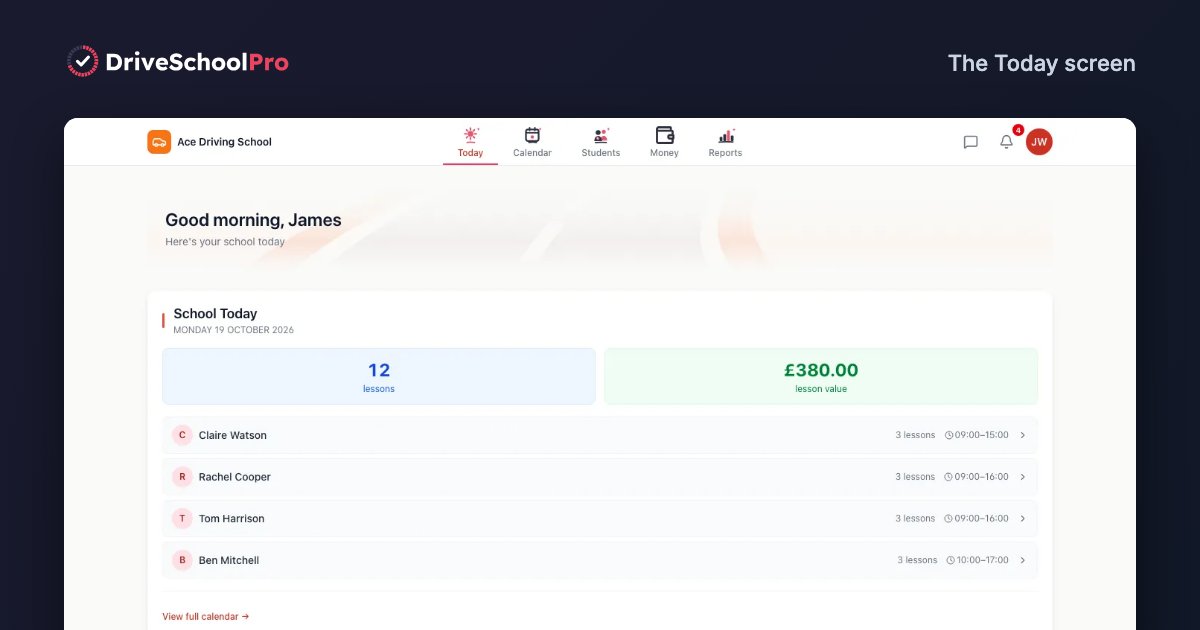
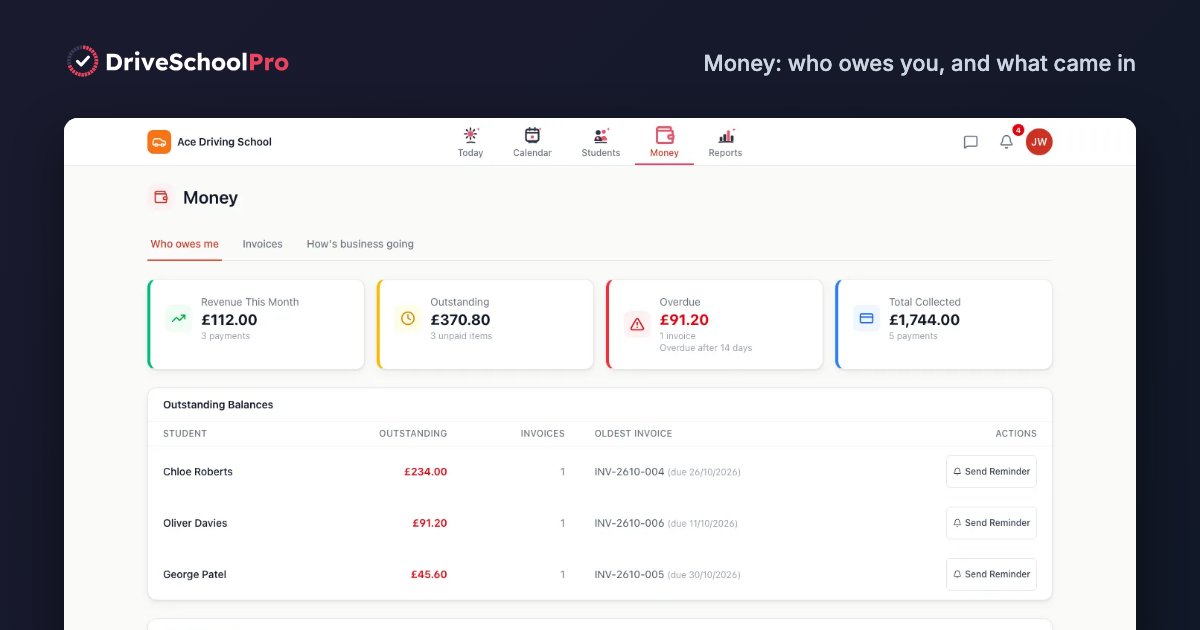
Accounting software handles the expenses, the car, the bank feed and the submission to HMRC. What it can’t see is which pupil paid for which lesson, who still owes you money and how much you took in each quarter. That is the job of driving school software.
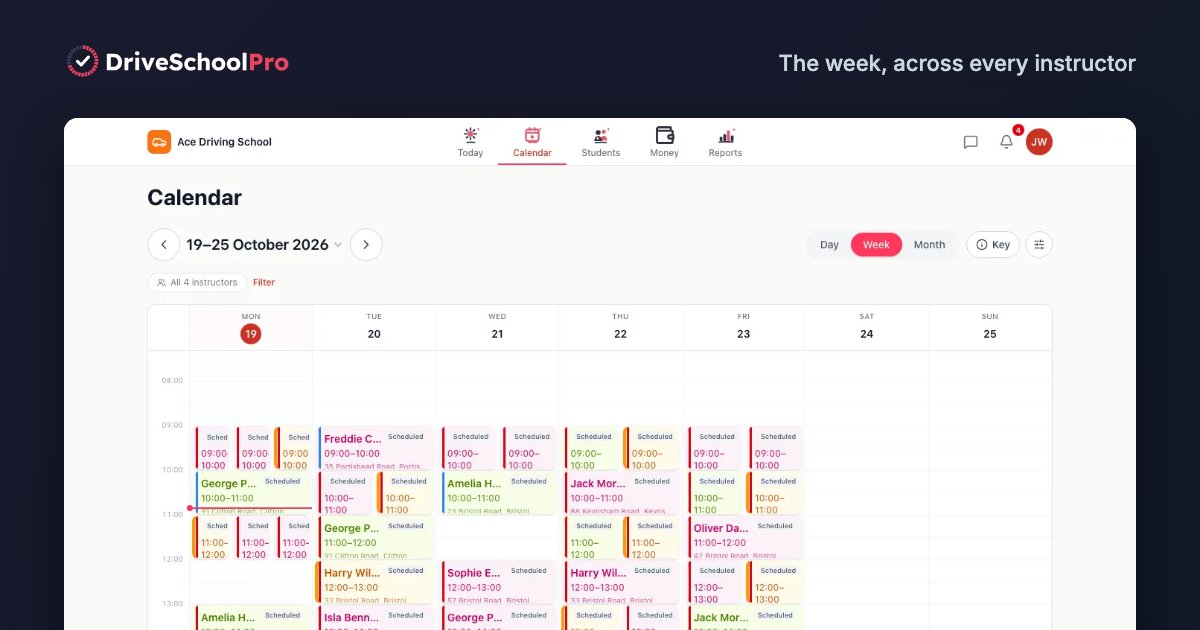
DriveSchoolPro records every booked lesson, the invoice you send and the payment you receive, whether by card, cash or bank transfer. That gives you an accurate income figure for each period without rebuilding it from your diary. It is not MTD software and does not file anything with HMRC, so you will still need accounting software or an accountant for the submission.
DriveSchoolPro is free until 31 March 2027. From 1 April 2027 there’s a permanent Free plan for one instructor and up to 60 lessons a month, or Solo at £22 a month with no VAT charged. See pricing for details.
Related guides
- MTD record keeping for driving instructors: the digital records to keep, typical ADI expenses and the mileage choice
- Choosing MTD software for driving instructors: an 8-point checklist and questions to ask before you sign up
- MTD timeline for 2027 and 2028: every date from now to your first MTD tax return
- Accounting software for driving instructors: what bookkeeping software does that driving school software doesn’t
- Driving school payment processing: taking card payments and keeping track of who has paid
- How to start a driving school: registering as self-employed, insurance and setting your prices
- Driving school revenue calculator: work out your yearly lesson income before you check the threshold
DriveSchoolPro is free while we're in early access — until 31 March 2027.
Get started freeNo credit card required.